Definitions and Business Financial Health Framework
Small and Medium Sized Enterprises (SMEs) are an integral part of many of the economies around the world. These businesses stem job creation, drive innovation and contribute to GDP growth. Financial Resilience Institute recognizes this and the intense need to better understand and aid entrepreneurs in ensuring strong financial health and resilience for SMEs globally.
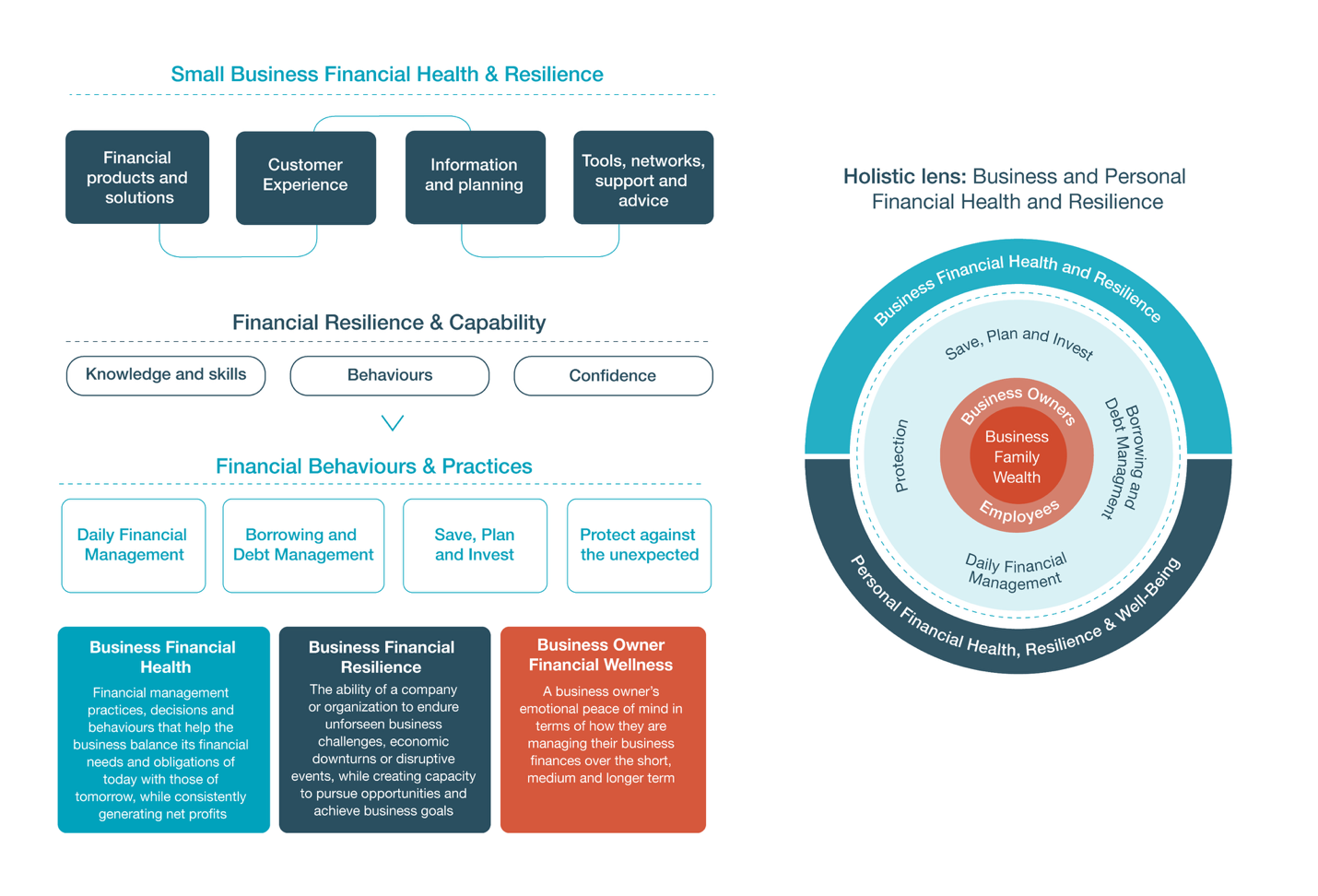
The proprietary Business Financial Health and Resilience Framework provides a framework for analysis of the financial health and resilience of Small and Medium Sized Enterprises (SMEs) and the relationship with the respective business owner’s personal financial health, financial resilience and financial wellness.
The framework focuses on business financial practices and behaviours across the spectrum of daily financial management, cashflow management, saving, planning, and investing (including succession planning), borrowing, debt management, and protection. It brings a holistic lens and set of indicators related to business financial health, financial resilience and business owner financial wellness. It brings a holistic lens on the business and personal financial health and resilience of a SME business; the business owner, their family and employees as appropriate.
The framework was developed over ten years by Eloise Duncan, CEO and Founder, Financial Resilience Institute. It has been informed by quantitative Business Financial Health Studies and research from the US, Canada, India and other countries; several qualitative consultations with Business Banking experts and SME bank customers in Canada [1,2]. In addition, the framework builds on the Personal Financial Well-Being Framework developed in 2016 [3].
For more data and insights around SME financial health and financial resilience, check out our Small Business Financial Health and Resilience Report.
Source: Financial Resilience Institute, Business Financial Health and Resilience Framework
[1] ‘Business Financial Health and Resilience Framework’ refers to a model developed by Seymour Management Consulting Inc. in 2021 and licensed by Financial Resilience Society (dba Financial Resilience Institute). This provides a framework for analysis of the financial health and resilience of Small and Medium Sized Enterprises (SMEs) and the relationship with the respective business owner’s personal financial health, financial resilience, and financial wellness. The framework focuses on business financial practices and behaviours across the spectrum of daily financial management, cashflow management, saving, planning, and investing (including succession planning) borrowing, debt management, and protection.
[2] ‘Financial Well-Being Framework’ refers to a proprietary framework developed by Seymour Management Consulting Inc., used under license by Financial Resilience Society, with this outlined on page 107. The framework provides a holistic view of the complex construct of an individual’s financial well-being. It includes definitions, indicators, and connections between the inter-related constructs of financial health, financial resilience, financial wellness, and financial capability which together impact an individual’s financial well-being. The framework has a focus on individual consumer and financial behaviours that impact individuals’ financial well-being across the spectrum of daily financial management, saving, planning, and investing, debt and credit management and protection. The framework is published on the Institute’s website at: https://www.finresilienceinstitute.org/definitions-financial-well-being-framework/
Building financial health and resilience can strengthen overall resilience, financial empowerment and peace of mind, contributing to improved financial well-being and overall personal well-being. It can also increase the capacity to achieve other outcomes that matter in life, including secure housing, supporting a family, education, business ownership and retirement.
The opposite of financial health and resilience is financial vulnerability. The Financial Health and Resilience Index measures it as the ‘flip side’ of financial resilience, helping identify household strengths and vulnerabilities, the factors contributing to different outcomes and where targeted support or intervention may be needed.
Financial health and resilience is not a fixed state or simply a measure of wealth. It can change as circumstances, needs, behaviours and external conditions evolve, and can be strengthened through the right evidence, choices, support, policies and interventions.
For individuals and households, financial health is about balancing the financial needs of today and tomorrow through decisions and behaviours that help people move forward. Financial resilience is the ability to withstand and recover from financial hardship, stressors or shocks arising from unplanned life events, such as job loss, illness, medical expenses, extreme weather events or economic downturns, while continuing to pursue life and financial goals.
Financial behaviours and decisions contribute meaningfully to these outcomes. Healthy financial behaviours, social capital and relevant financial products, services and interventions can all make a difference. Wider economic, social and structural conditions also matter, including income, employment, housing, health, caregiving responsibilities and access to appropriate support.
Like other leading organizations in this field, the Institute applies a Theory of Change approach to advancing improved financial well-being for individuals, households and other key stakeholders. This recognizes that outcomes are shaped by interconnected policies, market conditions, institutional practices, products, services, behaviours and personal circumstances, and helps identify how actions and interventions are expected to contribute to measurable outcomes over time.