Financial Health and Resilience Index for Households
Seymour Financial Resilience Index ®
The Institute’s proprietary, peer-reviewed Financial Health and Resilience Index Model is the world’s leading Index that measures household financial resilience in Canada, with application across many countries.
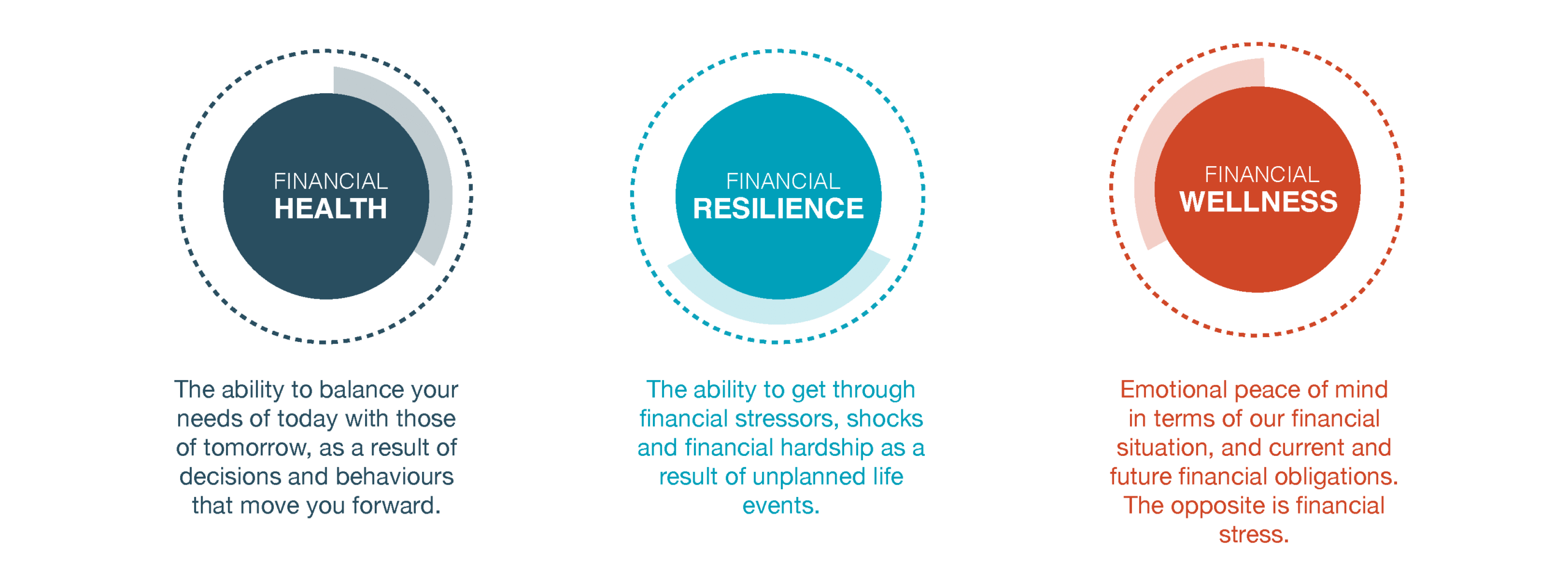
Financial Resilience is defined and measured as ‘a household’s ability to get through financial hardship, stressors and shocks as a result of unplanned life events.’ The Index measures household financial resilience at the national, regional or provincial, segment and individual household levels. It was created by CEO and Founder Eloise Duncan, with the support of her expert team.
Financial health and financial stress indicators are included within the Index, created based on our holistic Financial Well-Being Framework. Developed in 2016, this framework has strong alignment to the G20 definition of Financial Well-Being and measurement frameworks being developed globally.
The robust regression model and Index has a pre-pandemic baseline of February 2020, right before Covid-19 hit the world. The Index is based on survey-based data with over 5000 households from a representative sample of the population, with tracking three times a year between 2020 and 2026.
With February 2026 our sixteenth Index Release, the Index builds on over 10+ years of data analytics from the complementary Financial Well-Being Studies instrument (2017-2026) and has a rigorous development methodology process.
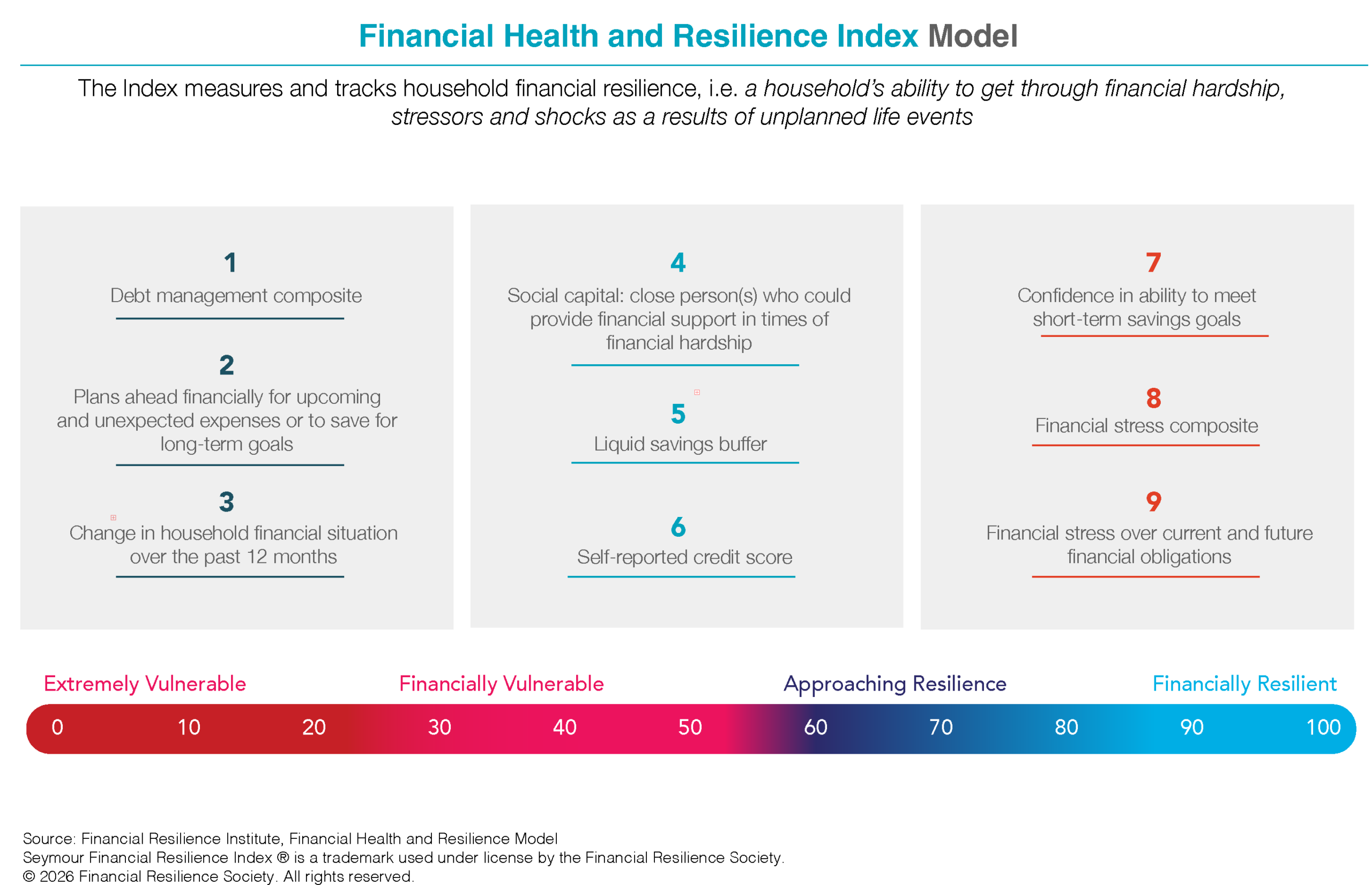
The Index measures financial resilience at the national, regional, segment and individual level across nine behavioural, sentiment and resilience indicators.
Peer-Reviewed and Recognized by World-Leading Institutions
The Index is being adopted or recognized by leading global Financial Institutions, Policymakers and others in Canada and globally, as we see an increased focus on of financial health and resilience impact measurement, innovation and systems change globally.
The Index and our instruments have been peer-reviewed and used by many organizations including: Statistics Canada, C.D. Howe Institute, Vancity, Standard Chartered Bank, Co-operators Coast Capital Savings, Royal Bank of Canada, FP Canada, Prosper Canada and others. It has also been recognized by leading organizations. These include UNEP-FI/ UN-PRB, IMF, World Bank, CGAP, UNSGSA, Bank of International Settlements (BIS), Canadian federal and provincial policymakers, Financial Consumer Agency of Canada, (FCAC), Financial Health Network, ING and many central banks, regulators and financial health leaders around the world.
Our frameworks and models also build on extensive consultation with leading financial well-being academics including Professor Elaine Kempson; customer in-depth consultations and qualitative analysis and leading research and analytics.
As of February 2026, the nine Index behavioural, sentiment, and resilience indicators explain 66% of the variance in the financial resilience construct. The model has remained consistently strong with all indicators having p-values of <.001.
Scoring Model
Index indicators are unequal and dynamic. This ensures the model is data-driven and unbiased, with the Institute not assigning weights based on assumptions. The Index reflects reality, so if the drivers of household financial resilience adjust in importance due to inflation, interest rate changes or consumer behavioural changes for example, this is reflected in the indicator weightings, enabling a powerful, dynamic model.
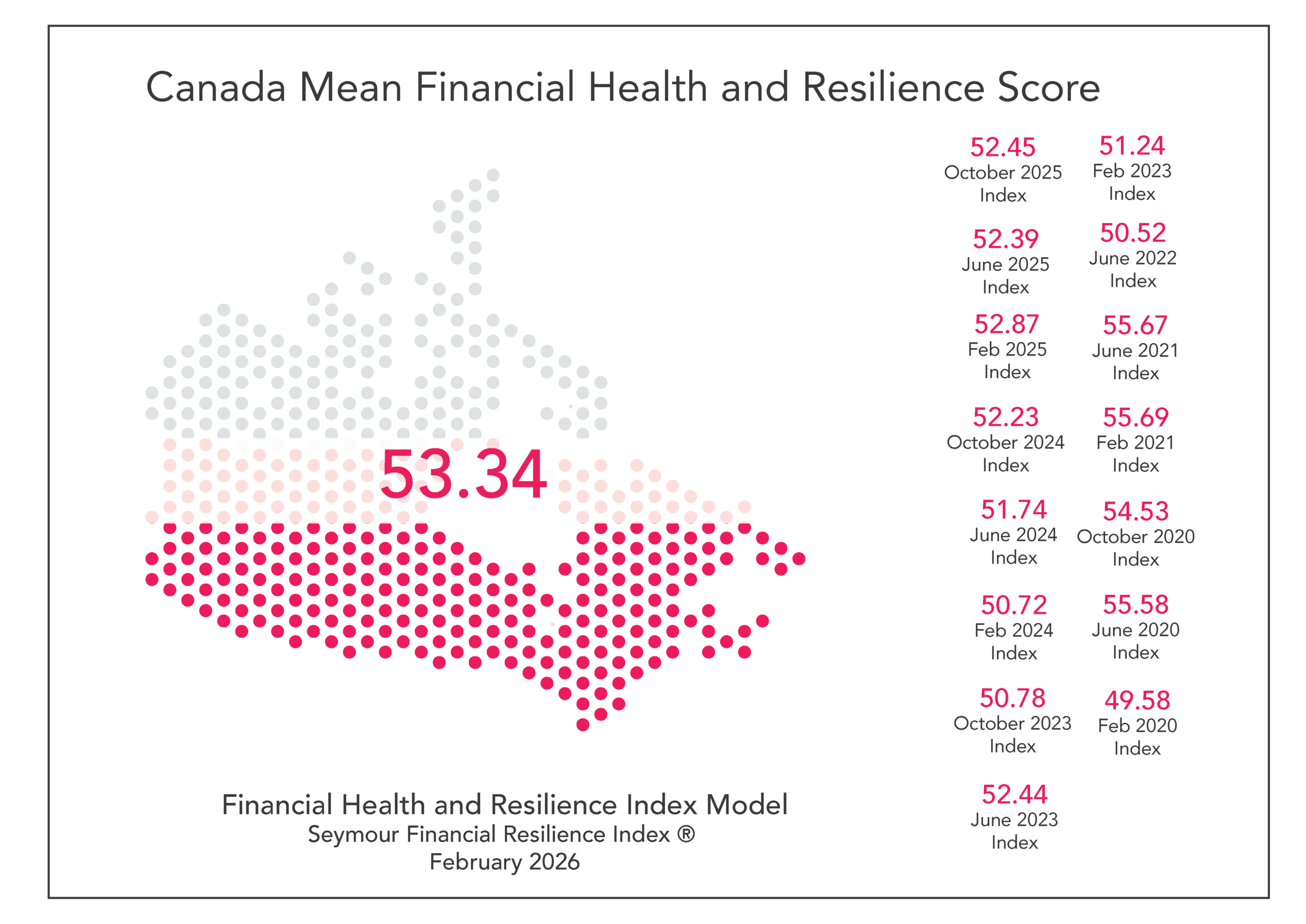
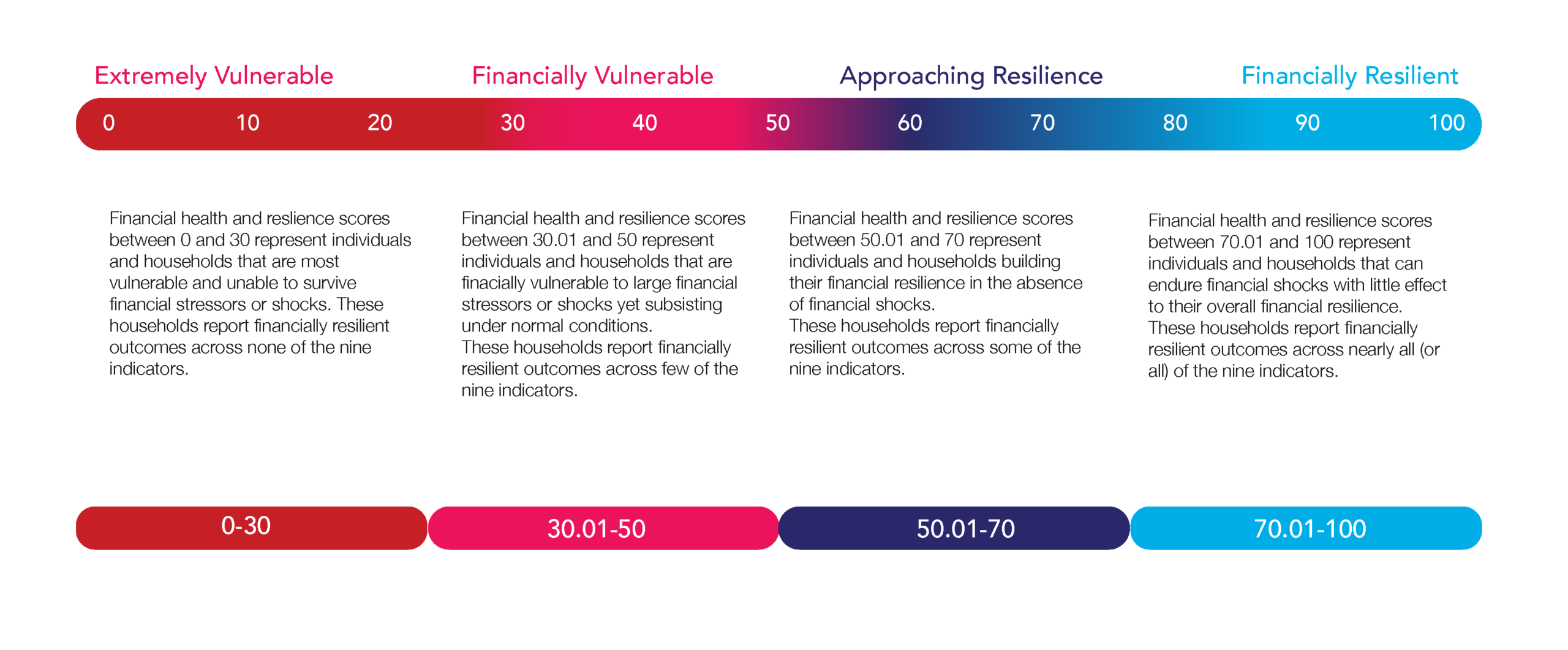
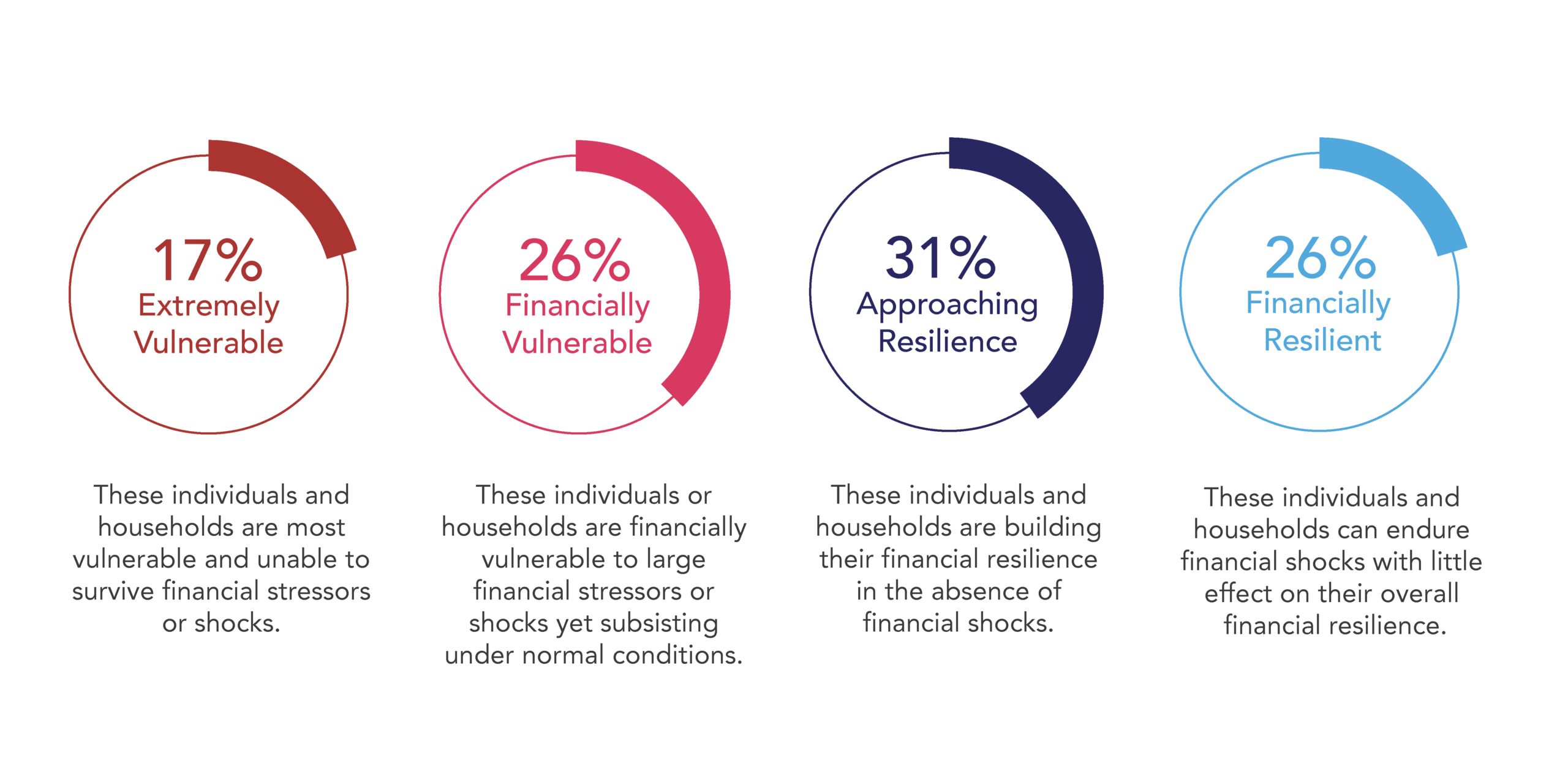
As of February 2026, Canada’s Mean Financial Resilience Score is 53.34, indicating households are only ‘Approaching Resilience’. Financial vulnerability spans all income levels, with 74% of households not ‘Financially Resilient’.
Financial Resilience Segments as of February 2026
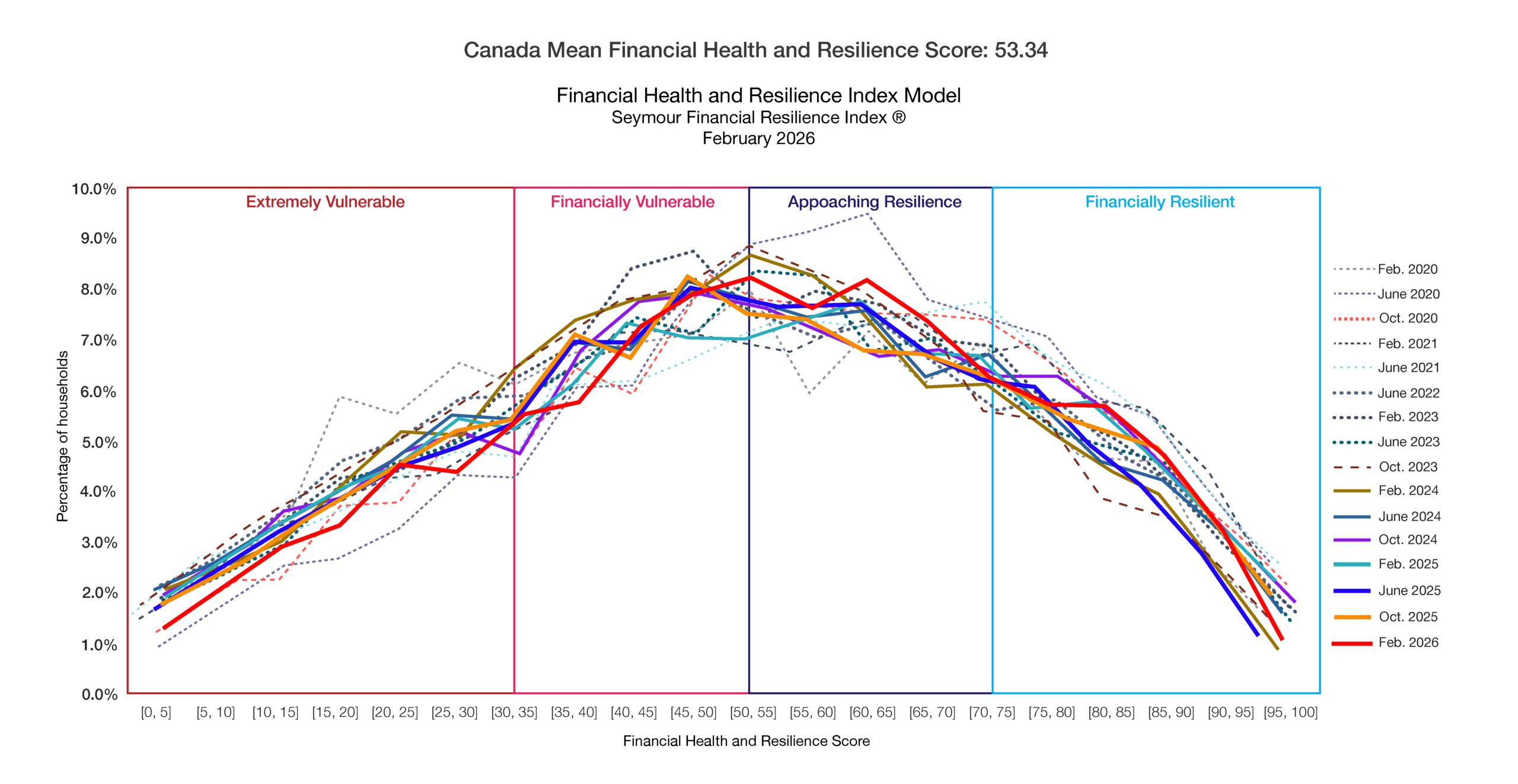
Index Distribution from February 2020 to February 2026
Multiple Applications
The Financial Health and Resilience Index enables independent longitudinal tracking of households’ financial health, resilience and financial well-being, benchmarking and custom analytics for organizations. It enables purpose-driven outcomes-focused analytics and annual (or bi-annual) tracking. The data garnered can be combined with macro financial stability, economic and transactional data, providing a unique and holistic lens on households alongside traditional metrics such as income, assets, GDP, financial product holdings, debt-to-income ratios, customer net promotor scores or poverty data.
The Index can be harnessed by Financial Institutions, regulators, Policymakers, Employers, financial health innovators and others to measure and track financial resilience, financial health and more for customers, employees, small target populations and communities, while accelerating positive change. At the same time, the Index and our team expertise can be used to help prove the power of key interventions on improved household financial resilience and financial well-being outcomes for customers, plus other financial, business and social impact benefits over time. This supports more targeted, data-driven decision-making and investments, including as international development is re-defined, and ultimately, helps to build more resilient, inclusive economies through systems change.
Combined with our specialist financial health expertise and methodologies our non-profit helps support robust, independent impact measurement, tracking and innovation. This also supports financial health strategy, innovation and impact, with our Institute also providing financial health strategy advisory, consulting and execution support based on our client or partners’ business needs to help them achieve their goals.
Drive Positive Financial Health and Resilience Outcomes
Our Institute brings proven methodologies to help you track and identify the key levers your organization can pull to measurably maintain or improve financial resilience, financial health and financial well-being of your customers, employees, citizens and target populations over time. This can include levers and interventions unique to your organization or delivered in collaboration with other ecosystem partners or players.
Track and Improve Financial Health and Well-Being
Utilize the Index to track financial health, financial well-being and strengthen financial wellness delivery for your existing and target customers, populations, employees, stakeholders and communities. The Institute’s Financial Well-Being Studies (2017–2026) also allows for the tracking of financial inclusion and access-to-financial help gaps facing key populations, alongside the impact of key financial and policy interventions on improved financial resilience outcomes and business, risk, customer and social benefits.
Advance evidence-based decision-making and accelerate impact
Through the utilization of the Index and our team expertise, your organization can leverage insights on the impact of key behavioural, policy and financial services interventions on improved financial resilience, financial well-being and overall well-being outcomes. This is made possible through Index analytics, benchmark data and reports, along with other customer, social and business benefits. The instrument has a longitudinal component and robust sampling and methodologies for comparability of data.
Customized questions and tracking through your client and partner studies attached to the Index are enabled through the Institute’s unique approach.
As an independent authority, the Institute enables organizations to understand the extent to which customers rate their Financial Institution or Employer for supporting their financial wellness over the past 12 months and related business benefits. We also support organizations in identifying which households are facing economic inclusion barriers and more.
Financial Resilience Institute has also developed proprietary models, beneficial for organizations globally. This includes the robust proprietary Financial Well-Being Index Model based on transactional banking data, developed in 2015 for a leading Financial Institution client by Eloise Duncan, CEO and Founder. The Index Model includes key indicators which were shared with UNEP-FI for its Financial Health and Inclusion Guidance for Banks. Our expert team can with you to leverage reported Index data and transactional data together across multiple applications and benefits.
You can understand your individual financial resilience score anytime
Individuals can check and understand their financial resilience score anytime through our free score tool, which is our robust Financial Health and Resilience Index Model made available at the individual household level by our non-profit.
If you live in Canada, you can also understand how your financial resilience score compares to others of a similar age and household income based on our Index and access a free bank of resources to help you manage and improve your financial health and resilience in your life.
By becoming a funder and partner of our non-profit Institute, your organization can amplify impact, reports and thought leadership, leveraging this instrument and others to catalyze positive change. Contact us to help build our capacity and explore partnership opportunities, we’d love to hear from you.
Canadians can check their individual financial health and resilience score and see how they compare with peers of similar age and household income. Scores are private and anonymous. Once they get their score, individuals can explore steps to maintain or improve their financial resilience and financial well-being over time.
Canadians can anonymously check their financial resilience score, see how they compare with peers of similar age and income, and explore steps to maintain or improve it over time.
They also have access to a free library of trusted resources, including materials from the Government of Canada and the Financial Consumer Agency of Canada, to support their financial well-being.
Provincial
Segment

Organization

Individual

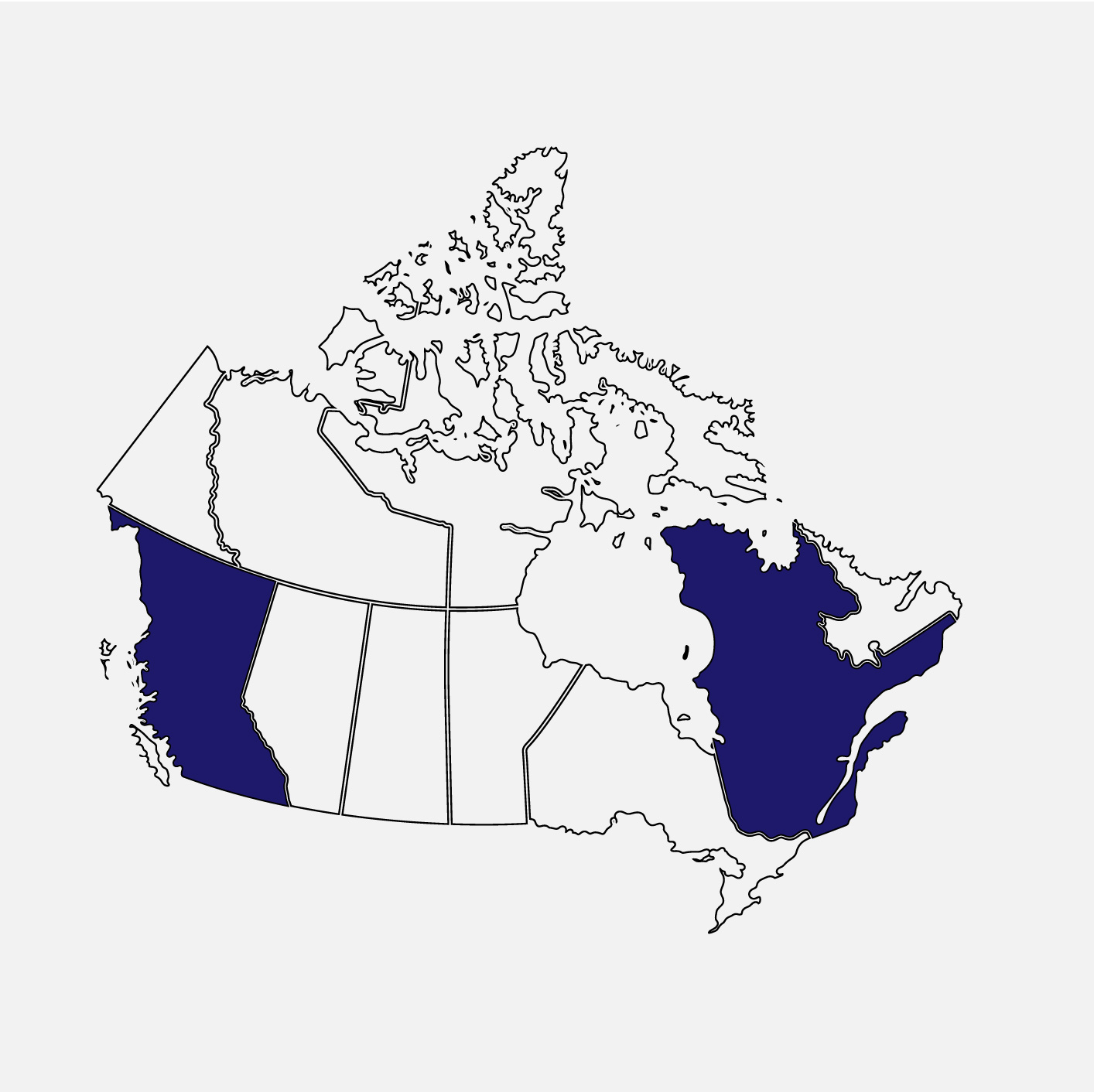
Provincial
Financial resilience measurement, analytics and tracking is available at a provincial level for comparative purposes. Provincial comparisons allow for national organizations to see provincial disparities within their markets and client bases.
Segment
Financial resilience and financial stress, health and well-being measurement, analytics and tracking is available for many consumer segments and sub-segments. These include for example: Millennial renters; Indigenous Canadians; tier-one bank customer mortgage holders with good or fair self-reported credit scores and others. This allows organizations to understand the financial resilience of their target customers and prospects with multiple applications.
Organization
Financial resilience measurement and analytics is available for tier one Canadian banks and other organizations, enabling long-term impact measurement and customized financial resilience (and vulnerability) scoring at the organizational, portfolio or segment level for their organization. Customized studies and boost samples enable all types of organizations to measure their customers, employees or communities’ financial resilience and track this over time.
Individual Household
Financial resilience scoring and analytics is available for individual households, existing or prospective customers. Contextualized scores and analytics provided against the Index and longitudinal benchmark data with customized solutions and applications for organizations based on their needs. Contact us for more information if this is of interest for your organization.