MSME Business Financial Health and Resilience Index
Seymour Financial Resilience Index ®
The Institute has developed a robust MSME (Micro, Small and Medium Enterprises) Business Financial Health and Resilience Index model to provide an outcomes-focused measure of businesses’ financial resilience.
The strength of the Index is demonstrated by the eight Index indicators accounting for 63 percent of the variance in the business financial health and resilience construct. The Index represents an extremely strong model, with this R² being particularly strong given the complexity of MSMEs and in the context of Social Sciences.
The Index enables a forward-looking measure of MSMEs’ business financial resilience and provides financial authorities, financial institutions, policymakers and others with an early-warning signal of MSME financial stress and vulnerability, before it becomes visible through arrears, defaults, conventional banking or other indicators.
As a forward-looking tool, the Index has the potential to inform evidence-based policy and decision-making, as well as more targeted interventions and investments by policymakers, financial institutions and financial health innovators. It can also link these interventions and investments to positive outcomes, such as job creation for growing companies and, through improved business financial resilience or targeted financing, helping businesses to grow and thrive.
In light of supply chain disruptions, economic shocks, tariffs and other challenges facing MSMEs globally, the Index can also be utilized to track the impact of these shocks on businesses and economies, with multiple potential applications.
Similar to our non-profit Institute’s Financial Health and Resilience Index model, theBusiness Financial Health and Resilience Index enables independent longitudinal measurement and, importantly, the tracking of the impact of key policies and interventions on improved business financial health and resilience outcomes over time.
This measurement can be undertaken for a country’s MSME economy as a whole, for MSMEs at the regional level, at the segment level (for example, for Women-Led MSMEs) and right down to the individual business or organizational level.
Index Indicators
The Index measures businesses’ financial health and resilience across the eight indicators below, providing a holistic and multi-dimensional measurement of MSMEs’ business financial health and resilience.
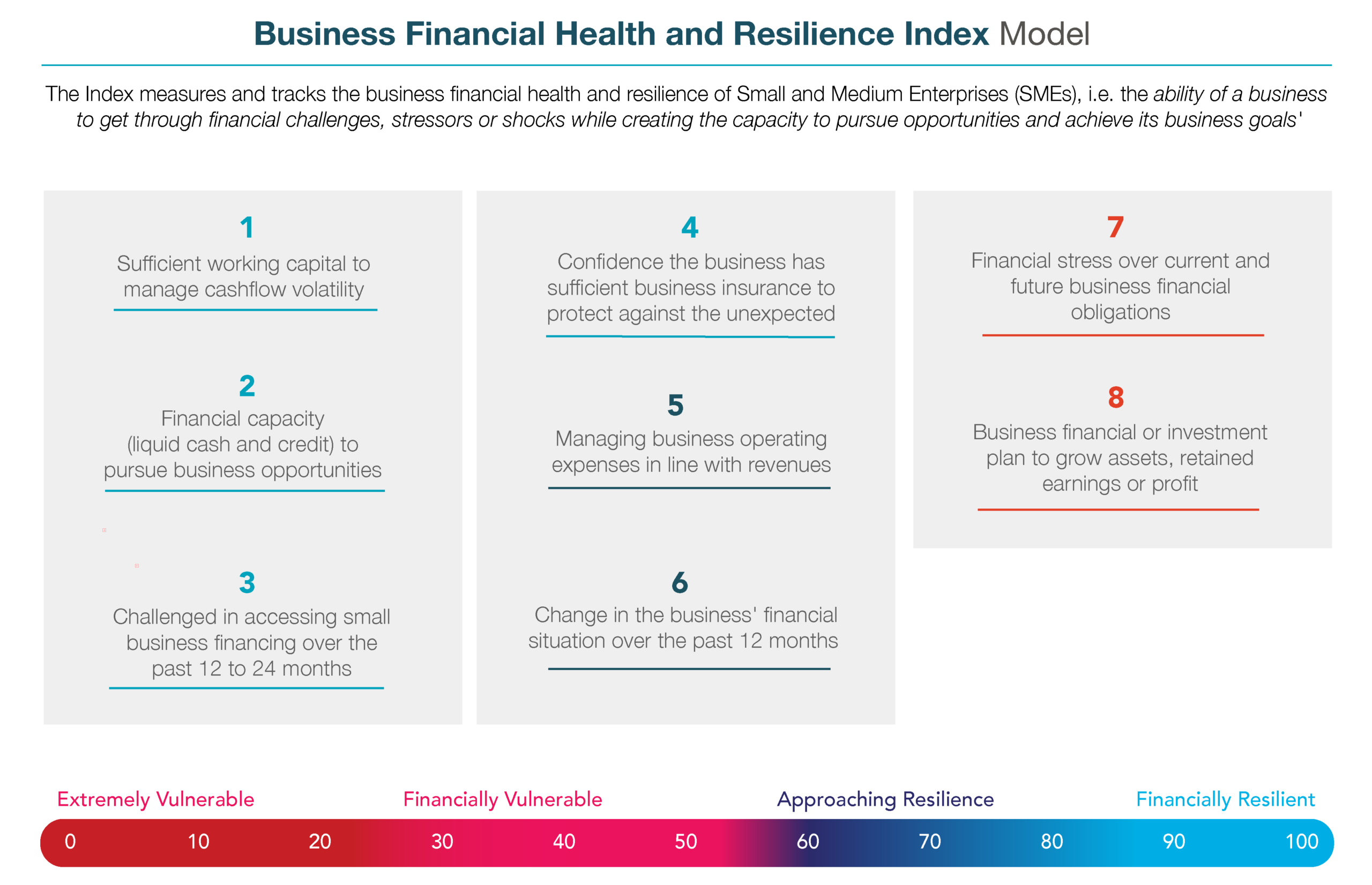
These indicators align with the Business Financial Health Framework and are categorized as ‘Financial Health’, ‘Financial Resilience’ and ‘Business Owner Financial Wellness’ indicators.
The eight Index indicators account for 63 percent of the variance in the business financial health and resilience construct. Index indicators are not equal.
Scoring Model
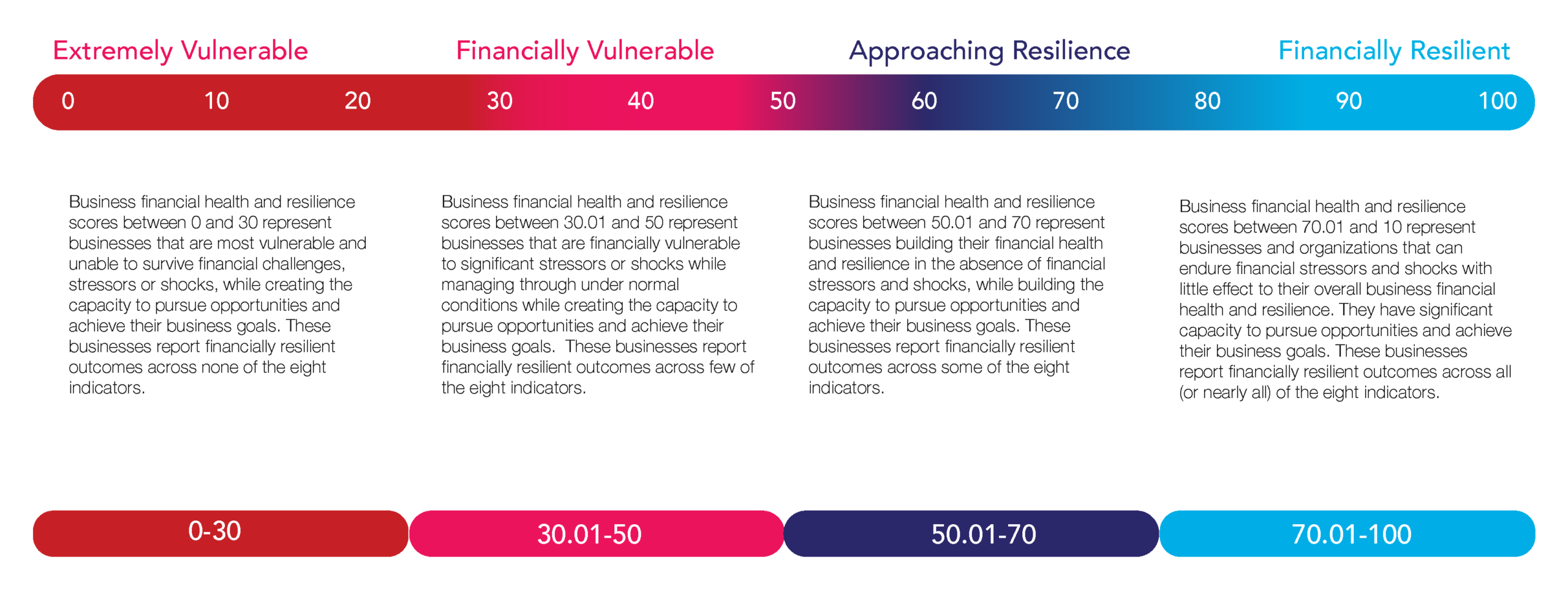
Micro, Small and Medium Enterprises (MSMEs) are scored based on the Index model from 0 to 100 based on the index indicators.
‘Extremely Vulnerable’ businesses have a business resilience score of 0 to 30. ‘Financially Vulnerable’ businesses have a business financial resilience score of 30.01 to 50. ‘Approaching Resilience’ businesses have a business financial resilience score of 50.01 to 70, and ‘Financially Resilient’ businesses have a business financial resilience score of 70.01 to 100.
Disaggregated data analytics enables tracking of more financially vulnerable or underserved businesses, with extensive firmographics captured to complement the Index indicator data and measurement tool.
A More Complete View of Economic Financial Health and Resilience:
Connecting Macro Data with Household and MSME Outcomes
Used in tandem with the Personal Financial Health and Resilience Index, or other financial health data, the Business Financial Health and Resilience Index provides policymakers, financial authorities, central banks, financial institutions and others with a more fulsome and multi-dimensional view of the financial health and resilience of households, MSMEs and the economy.
This enables traditional macro-economic and financial stability data to be considered alongside multi-dimensional measures of households’ financial health and resilience and MSMEs’ business financial health and resilience. Together, these measures can provide a more complete understanding of financial health, resilience, stress and vulnerability at the national, provincial, segment and micro-data level.
This more fulsome evidence base can support policymakers, financial authorities, central banks and others in identifying where financial stress and vulnerability are emerging across households and MSMEs; understanding which regions and segments are experiencing greater challenges; tracking changes in financial health and resilience through economic shocks; and measuring whether policies, financing and other interventions are contributing to improved outcomes over time.
In this way, the Household and MSME Indexes can complement traditional macro-economic and financial stability measures with outcomes-focused measures of financial health and resilience, strengthening the evidence available to inform policy, financial stability considerations, targeted interventions and investments.
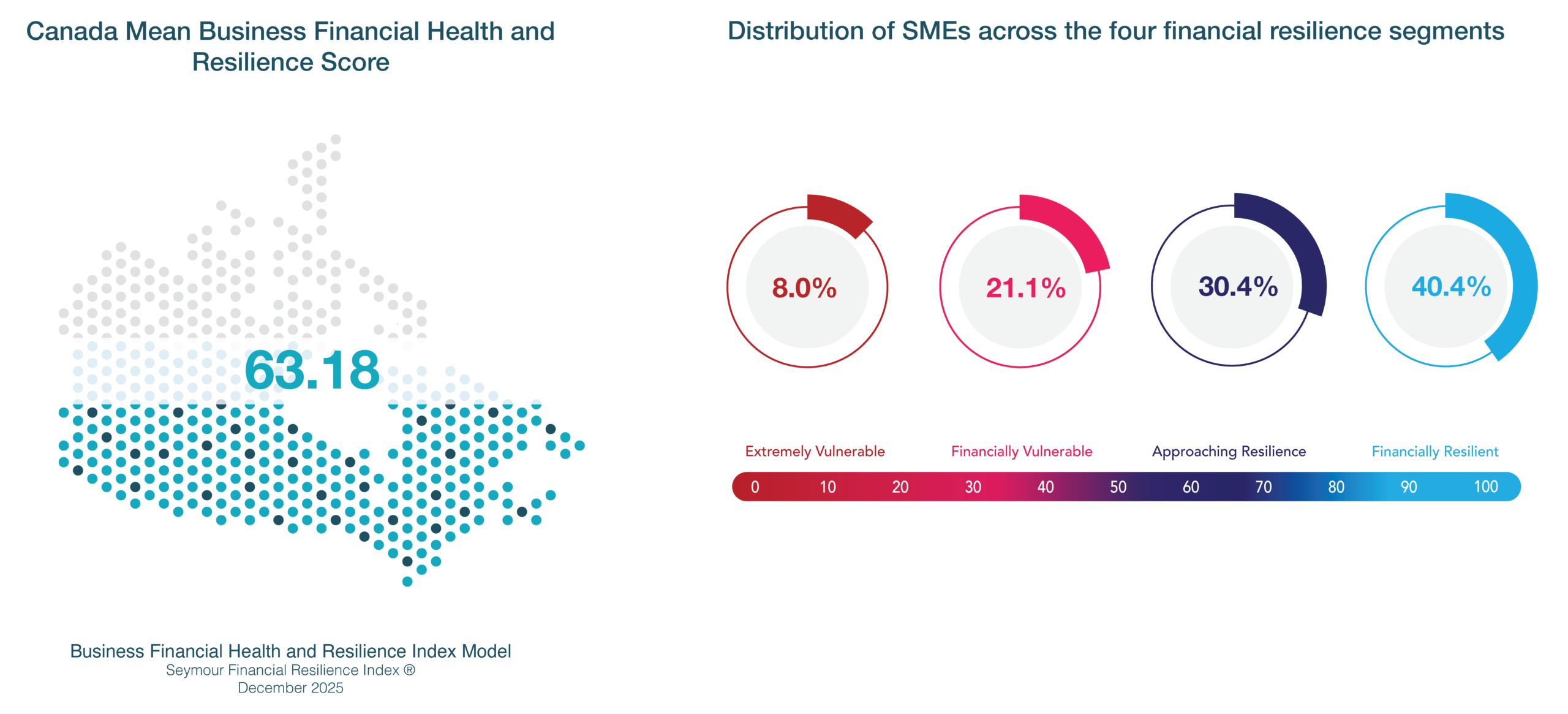
Canada’s Mean Business Financial Health and Resilience Score, based on the first Baseline Index data, is 63.18 as of December 2026. At this time, MSMEs nationally were ‘Approaching Resilience’ based on the Index, with just over 40% of MSMEs ‘Financially Resilient’.
Importantly, this first Baseline Index measurement was established before the geopolitical and trade issues between Canada and the US and the associated economic impacts. These issues provide one example of an external stressor or economic shock that can impact the business financial health and resilience of MSMEs, both across the MSME economy as a whole and, importantly, for sectors and segments more significantly affected than others. The Baseline therefore provides an important benchmark against which changes in MSMEs’ business financial health and resilience, and the differential impacts of such shocks, can be tracked over time. It can provide evidence to help policymakers to target policies, interventions and supports to help strengthen the financial and overall resilience of MSMEs as a critical engine of our economies.
The Baseline Index data also highlights important differences between segments of the MSME economy. There is a significant difference between the mean business financial resilience score of Women-Led MSMEs compared with Men-Led MSMEs, reinforcing the need for more intentional support of Women-Led MSMEs. Women have also experienced challenges in terms of financing, as evidenced in the Canada Business Financial Health and Resilience Ecosystem Report.
Applications
The Business Financial Health and Resilience Index has more Applications. It has the potential to provide policymakers, financial authorities, financial institutions and other stakeholders with a new evidence base for understanding, strengthening and tracking the financial health and resilience of MSMEs.