
Financial vulnerability: the flipside of individuals’ and households’ financial health and resilience.
May 2026
Authors: Eloise Duncan, CEO and Founder, Financial Resilience Institute
Introduction and Context
This article builds on the excellent policy brief developed by the Bank of International Settlements (BIS) Financial Stability Institute and United Nations Secretary-General's Special Advocate for Financial Health (UNSGSA) ‘Digitalisation and Innovation – Opportunities and Risks for Financial Health’ (April 2026). We recognize the authors of this report, Jon Frost, Jermy Prenio, Vatsala Shreeti and David Symington, and all contributors and reviewers of the report [1].
This short article includes some of the research and content from this brief and provides additional considerations with relation to opportunities for measuring the impact of digitalized products, lending or other interventions on the household financial health and resilience outcomes, leaning into research and analytics led by our non-profit Financial Resilience Institute over the past decade with potential applications for other countries.
Impact measurement in the area of financial health and resilience is a journey with many more learnings to come. We look forward to collaborating with other institutes, financial health leaders and innovators to help advance financial health and resilience impact measurement and innovation, while catalyzing positive change for people, businesses, communities and our world. Financial health is increasingly recognized as a factor contributing to financial stability, financial well-being, inclusive growth, resilience building and other aspects of individual and societal well-being. In the financial sector, the financial health and resilience of customers and employees contribute to the sustainability, profitability and stability of financial institutions. The G20 Policy Note on Financial Well-Being (2024) comprises a conceptual consensus on financial well-being, with our Institute and other organizations progressing work in this area since 2015.
The BIS-UNGSA brief highlights the important role of financial regulators in advancing financial health and resilience outcomes for citizens and financial institution customers, alongside opportunities for public-private partnerships and the criticality of robust, disaggregated measurement of household financial health. As outlined by the authors, “measuring what matters through robust disaggregated financial indicators that combine objective and subjective metrics, can help target interventions and track outcomes. Effective responses will rely on collaboration among financial authorities, market participants and other stakeholders, with a clear focus on consumer protection and long-term financial well-being."
This can entail tracking household financial vulnerability and other economic outcomes as populations take up financial products, such as digital lending, and/or are impacted by financial or regulatory policies and interventions over time.
Digitalization and Innovation for Financial Health: Measurement and Example Risks and Opportunities
Digital innovation and offerings such as mobile money or digital lending can be inclusive and impactful in financial sectors. However, they can also create risks, including by enabling fraud and scams, and increasing access to credit and investment products that may lead to excessive debt or risky investments. Our research and analytics in Canada validate this, with households using certain more predatory lending products (such as payday loans for example) having significantly increased household financial vulnerability. In addition, our research highlights a correlation between households receiving certain financial help and support (for example help in managing their debt over the past year) and improved household financial resilience outcomes. Data and insights are published in the ‘Financial Inclusion as a Pathway to Financial Resilience’ report (November 2025) and other reports.
Leveraging alternative data and measuring the impact of digitalization, financial products and services on household financial vulnerability or financial health and resilience can enable more targeted interventions that improve financial health and financial well-being outcomes.
As the BIS brief outlines, “digital innovation improves households’ financial health and resilience is an empirical question”. We agree fully and put forward that this requires measuring the impact of households taking up certain products or digital financial innovations, and the resulting improvement or deterioration in financial vulnerability and other economic outcomes. New or enhanced regulatory experimentation, testing and public-private collaboration can also help to progress understanding, impact measurement and to help decision makings invest in interventions that count, while managing risks.
Financial health and resilience require baseline tracking, measurement of intermediate and end-impact outcomes
There are different approaches to impact measurement, with this complex and a journey, with significant value in researchers, institutes and financial health leaders working together to progress understanding and impact.
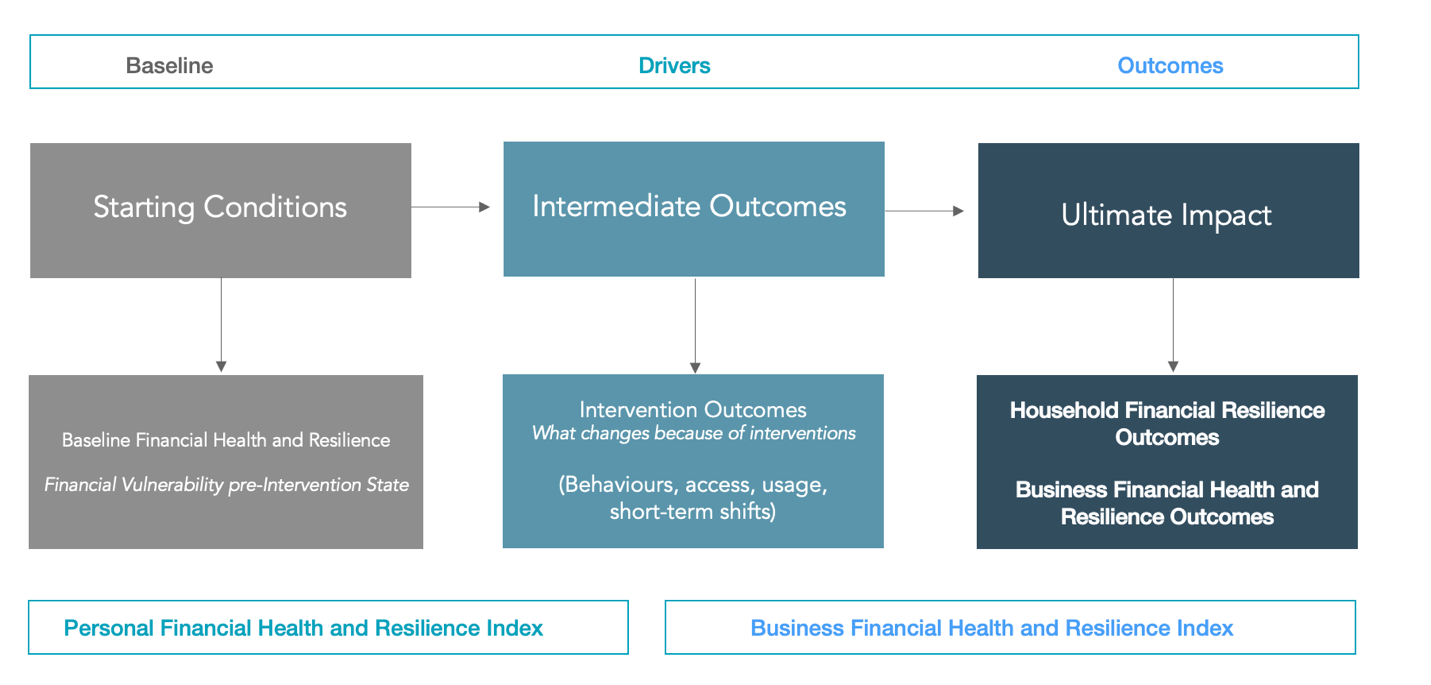
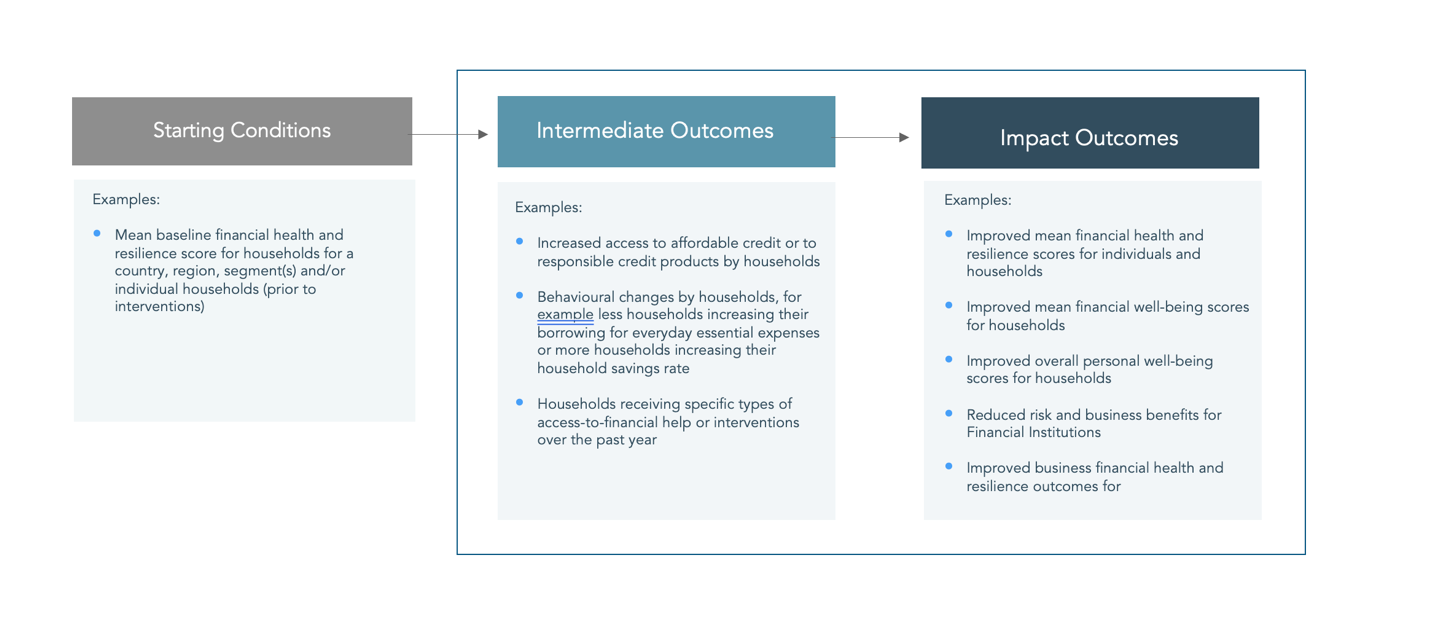
Financial Resilience Institute has proven methodologies for measuring foundational ‘starting conditions’ or baseline data for studies, intermediate outcomes and ultimate impact outcomes. This is valuable for enabling measurement, for example, the impact of access to responsible credit solutions, or improved debt management behaviours, on the improved household financial health and resilience (‘Ultimate Impact’) outcomes for individuals and households over time, as outlined in the visuals below.

We measure and track ‘starting conditions’ baseline measurement, for example the income level and mean financial health and resilience score of a particular household segment, before any intervention has taken place.
Intermediate outcomes can then be measured and tracked, for example whether a certain type of digital lending has been accessed by this household over the past year, or the household exhibits different borrowing or debt management behaviours over time.
Qualitative research insights from users of the products or services, or receivers of the intervention, can also shine a light on the extent to which the offering or intervention was an enabler that made a difference on the households’ financial stress, financial resilience and more.
Products, services and policy interventions can be enablers of individuals adjusting their behaviours or taking other steps that ultimately improve their household financial health and resilience. This can lead to improved household financial health and resilience outcomes for a household or segment, with more details in the visual below.
This provides the potential to measure financial practices and responsible lending products that help to drive improved household financial health and resilience outcomes, compared to ones that may cause increased household financial vulnerability [2].
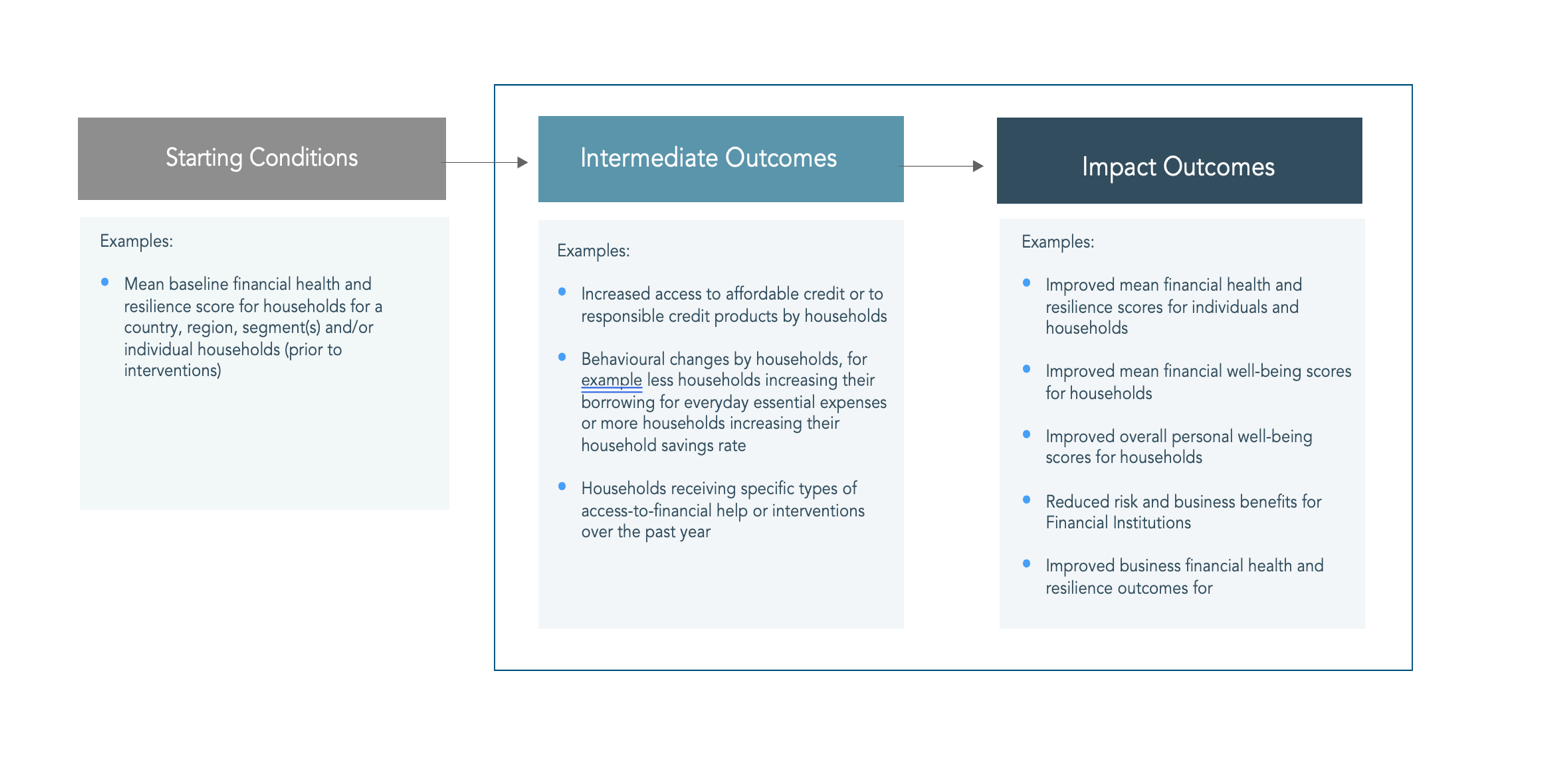
This research, analytics and impact measurement can enable more targeted decision-making, improving policy and innovation over time. Tools and frameworks to measure financial health, resilience and financial well-being vary. Survey-based studies capture behaviours, stress and resilience indicators, while transactional data provides real-world behavioural insights and indices enable outcomes measurement.
Financial Inclusion can be a pathway to financial health and resilience, but isn’t always
As outlined in the brief, in some countries, such as Kenya, financial health outcomes have deteriorated despite digital innovation and increased financial inclusion. Households classified as ‘not financially healthy’ rose from around 60% in 2016 to 80% in 2021, alongside increased digital lending and mobile money usage. This and our work in Canada highlight that financial inclusion can be, but is not always, a pathway to improved financial health and resilience outcomes for individuals or households.
Based on the Institute’s peer-reviewed Financial Health and Resilience Index Model in Canada data analytics, healthy financial behaviours of individuals, such as saving or planning ahead financially, correlate strongly with improved financial health and resilience outcomes. However, certain financial products and services can cause harm while certain financial behaviours, such as a household increasing their debt for everyday expenses, correlate to increased financial vulnerability. While digital technology can facilitate access to financial services that can improve financial health, the empirical link between financial inclusion and financial health is not always clear. Responsible credit and healthy financial behaviours, such as planning ahead financially even in a small way or minimizing non-essential expenses to free up the capacity for saving even a small amount regularly, can measurably make a difference.
Baseline measurement and longitudinal tracking enable understanding in where households at in terms of their financial health and resilience, before any interventions
While longitudinal research and analytics enables measurement of household financial health and resilience (with the flipside being financial vulnerability) over time; intersectional analysis validates that households facing more than one systemic barrier are measurably more financially vulnerable. This is prior to them taking up any digital innovations, lending or other financial products, or being impacted by a policy or other intervention.
For example, female single parents living with a low income in Canada are significantly more financially vulnerable based on the Institute’s peer-reviewed Financial Health and Resilience Index Model, with those facing more than one barrier even more financially vulnerable. As of February 2025, for example, female single parents had a mean financial health and resilience score 8 Index points lower (at 30.9) compared to female single parents not living with a low income (39.2) [3].
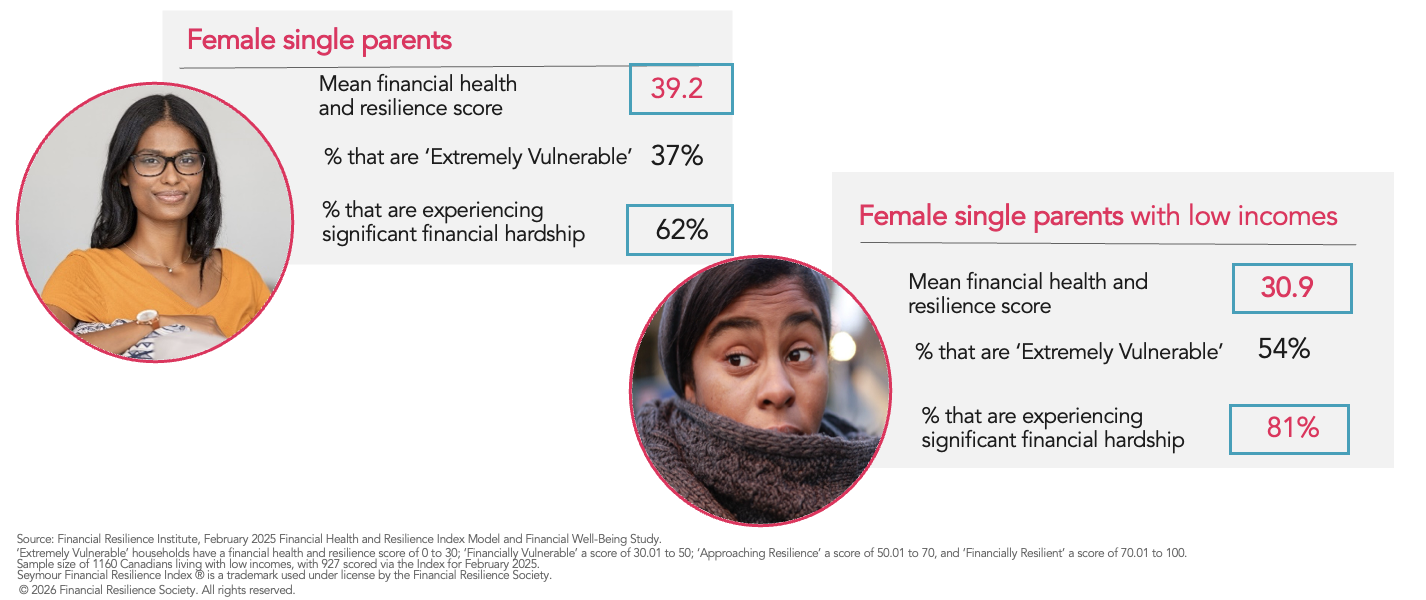
We believe it is important to understand which populations are more financially vulnerable or facing systemic barriers, and how their financial health and resilience stack up at a point in time. This includes before they have received any interventions and/or taken up certain financial products or services made available through digitization, such as mobile money or digital lending. These interventions can be enablers of improved financial health and resilience outcomes. However, a more nuanced view on households’ financial health and resilience for key populations based on dis-aggregated data and Index analytics is important, along with tracking on what is happening for more financially vulnerable households or populations. Leveraging survey-based data and indicates, combined with transactional or ‘real-life’ behavioural data can bring additional power in terms of identifying opportunities for nudging, interventions and support.
In this way, one can understand the impact of financial or regulatory policies, and/or which financial products, services, interventions or help lead to improved or deteriorated financial health and resilience outcomes for individuals and households. As outlined in our ‘Financial Inclusion as a Pathway to Financial Resilience’ Report (November 2025) studies like these can help test and potentially answer the question around the impacts of, and risks and opportunities related to digitalization for advancing financial health, while conducting deeper causal modeling where required, and enriching quantitative insights through lived-experiences garnered through qualitative research. This can help spotlight opportunities to advance financial health and resilience for citizens overall and key populations, while levering policies and interventions that may have been successful in other jurisdictions, and conducting pre-and-post intervention analysis.
Spotlight: Payday Loans Increase Households’ Financial Vulnerability in Canada, especially for more Vulnerable Populations
Households that have taken up payday loans or informal credit over the past 12 months have a mean financial health and resilience score of 26.6 as of February 2025 based on the Institute’s Financial Health and Resilience Index Model, used in tandem with our Financial Well-Being Studies instrument to enable disaggregated data and index analytics for key populations.
This is a significant 27 Index points lower than those who have not taken up these predatory products. Among low-income households, the ‘financial vulnerability’ outcomes gap is even more severe for households that have taken up these payday loans over the same period.
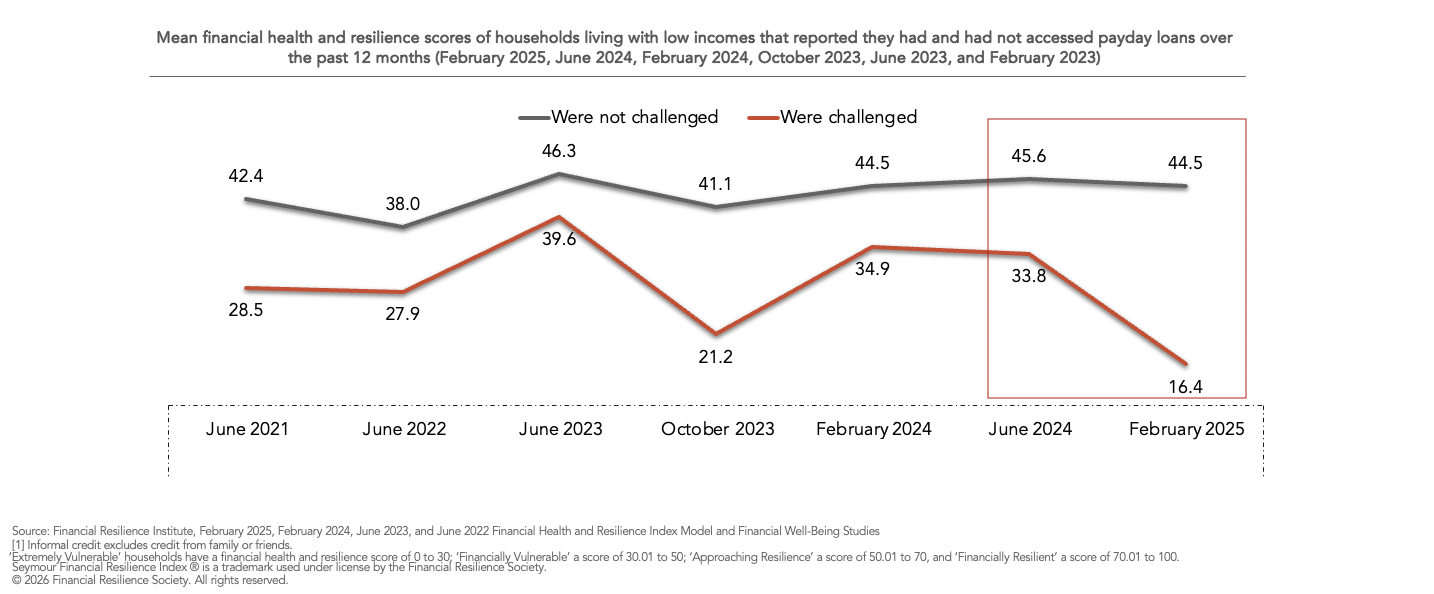
As of February 2025, Canadians living with low incomes that report they have not accessed payday loans or informal sources of credit have a mean financial health and resilience score of 44.5, with these households ‘Financially Vulnerable’. In contrast, low-income households that have taken up these predatory loan products have a mean financial health and resilience score of just 16.4, with these households ‘Extremely Vulnerable’. Their household financial vulnerability has also deteriorated significantly between February 2024 and February 2025.
This data validates the importance of Financial Authorities and agencies like Financial Consumer Agency of Canada, working to educate more Canadians around the risks and impacts of taking up predatory payment products. This can be relevant in other markets, such as South Africa and other countries, where there is evidence of increased online gambling, reliance on credit for everyday essentials and household financial vulnerability.
Financial Education, Nudging and Support Matter
Financial health leaders can work to start to understand and test which interventions can make more (or less) of a difference, either positive or negative. This can inform opportunities for enhanced consumer protection, consumer education and behavioural finance changes that help households think about and engage in their financial health and resilience decisions; adjust their consumer or financial behaviours, and/or access relevant products and services that help them maintain or improve their financial health and resilience, while realizing their life or financial goals. Understanding key levers ecosystem players (such as Financial Institutions) can pull, compared to behaviours and potential actions citizens or consumers can take to maintain or improve financial health and resilience for households and small and medium sized businesses will enable more targeted interventions and supports, including through peoples’ lives and through planned and unplanned events, stressors or shocks.
We believe that financial authorities, regulators, financial institutions, policymakers and others with a stake in the financial health and resilience of their populations require evidence-based, timely data to inform their policy decisions. Financial health leaders and policymakers can benefit from independent, longitudinal measurement of the impacts of key financial innovations, products, policies or digitalization on the household financial vulnerability of key populations.
This is why we created the peer-reviewed Financial Health and Resilience Index and Financial Well-Being Studies instrument, with application for other countries, and are working with institutions to create proprietary models and pathways that suit their country, business and impact needs.
These instruments, and others, help measurably move the dial on financial health and resilience outcomes, while identifying key levers financial institutions (or employers, or policymakers) can pull – alongside action steps consumers can take to maintain or improve their financial health and resilience over time.
This is a journey, with cross-sector collaboration and continuous testing-and-learning, innovation and impact measurement leading to more relevant interventions for key populations key to success.
Summary
The digitalization of financial services and changing consumer behaviours create both opportunities to advance financial health and resilience and risks, with this a complex picture. Greater financial inclusion and access to digital lending, and similar services, can cause increased household indebtedness, and the rise in fraud and scams is increasing the financial vulnerability of households globally.
Globally, as outlined by the Bank of International Settlements, policy frameworks can evolve to capture the benefits of digitalization and innovation, while mitigating harm. To do this, an outcomes-focused approach to understanding the impact of new technologies and financial services, alongside strengthening financial capabilities, financial consumer protection and regulation is needed on household financial health and resilience outcomes. Targeted measures will be important, along with measuring outcomes and intermediary outcomes or interventions as well.
This will be a journey, but together, financial health innovators can work to advance financial health, foster resilience, build inclusive economies, improve lives and manage risks.
The Institute regularly reports on the financial health, resilience, well-being and financial inclusion of key populations, including for Canadians living with low incomes. For more data and insights: https://www.finresilienceinstitute.org/low-income-canadians-reports/
View all the Institute's reports utilizing the Financial Health and Resilience Index Model and other instruments: https://www.finresilienceinstitute.org/all-reports/
[1] Source: FIS Brief 31: Digitalization and innovation – opportunities and risks for financial health. While different countries and institutions are progressing measurement locally, at the international level, CGAP is developing global technical guidance on financial health measurement, informed by early country experiences and consultation from financial health leaders. This guidance includes high-level framing and specific measurement indicators aligned with the CPFI (Global Partnership for Financial Inclusion) consensus definition and draws on both supply and demand-side data sources.
[2] Financial health and financial well-being measurement is complex and multi-faceted, which is why our Institute uses robust indices (such as the Financial Health and Resilience Index) and instruments (such as the Financial Well-Being Studies Instrument) in tandem to measure outcomes that matter. Survey-based data, analytics and benchmarking can combine with transactional ‘real life’ data on borrowing and loan repayment patterns and more collected by organizations, for a full picture of what is happening for a household, while progressing understanding of interventions and offerings that make a difference.
[3] Based on the Financial Health and Resilience Index Model: ‘Extremely Vulnerable’ households have a financial health and resilience score of 0 to 30, 'Financially Vulnerable' households a score of 30.01 to 50, 'Approaching Resilience' a score of 50.01 to 70 and 'Financially Resilient' households a score of 70.01 to 100.
Source: Financial Resilience Institute , Financial Health and Resilience Index Model, Seymour Financial Resilience Index ®
Seymour Financial Resilience Index ® is a trademark used under license by the Financial Resilience Society.
© 2026 Financial Resilience Society. All rights reserved